







After Wisdom Tooth Removal
Removing an impacted tooth must be done carefully, and proper post-op care is extremely important. If not cared for properly, serious pain, infections, and swelling may result.
Immediately Following Surgery
After your surgery, you will experience numbness from your anesthetic for two-six hours. For some time, you will also be biting on a piece of gauze.
- It is common to cry and suffer from emotional behavior after your treatment. This is due to your anesthesia and will not last long.
- Dr. [doctor_name] recommends that you remove your gauze after 45 minutes. If the oozing has not ended, please bite on another piece of fresh gauze for another 45 minutes. Continue this process until the oozing has stopped.
- After your bleeding has stopped, we recommend that you attempt to drink. Milkshakes, smoothies, pudding, and applesauce are good choices. During this time, do not use straws.
- As soon as you are able to take liquids, we recommend that you take Ibuprofen. This will be prescription strength, meaning you should take only one at a time and not more than four in a day. You should take this Ibuprofen every six hours.
- After four-six hours, we recommend that you start taking your narcotic medication. Vomiting and nausea are common side effects of anesthesia and narcotics. These effects are generally worse when taken on an empty stomach. Taking the narcotic is not a necessity—if you do not need it, you can choose not to take it.
- Our oral surgeon recommends that you apply an ice pack to your mouth for twenty minutes every two hours. Keep your head elevated to decrease pressure on your jaw.
- Stay hydrated during the healing progress. However, it is extremely important to avoid alcoholic beverages during this time.
- Do not smoke. Cigarette smoke can lead to prolonged pain, discomfort, and other complications. We recommend that you avoid smoking for at least ten days.
- It is common to bleed for two days after your surgery. If the injury is bleeding actively, we recommend that you bite down on a new piece of gauze for 45 minutes. Do not rinse or spit vigorously while you are bleeding. If bleeding persists, we recommend biting a moistened tea bag for 30 minutes.
- Most of the stitches used are dissolvable and will usually not last more than a week.
- You should eat soft foods for the first two to three days. Some of the foods we recommend are:
- Ice cream / Yogurt
- Pudding
- Pancakes
- Jell-O
- Soups
- Mashed potatoes
- Scrambled eggs
- Sorbet
- Popsicles
- Milkshakes
2-3 Days After Surgery
- You will be given medication that minimizes swelling, but swelling cannot be eliminated completely. Typically, peak swelling should occur by the second day after surgery.
- Your skin may take on a yellow, black, or blue tint, usually in the neck or check. This is not uncommon and can usually take a week to fade completely.
- We recommend that you begin brushing the first night after surgery. However, do not brush on the wound itself.
- Do not exercise vigorously for the first week after your surgery.
- If you take an oral contraceptive and have been prescribed an antibiotic, we recommend that you rely on an alternate method of birth control during this cycle.
3-4 Days After Surgery
- After three-four days, you should be able to move to soft foods that will require minimal chewing such as pasta and pancakes. We also recommend that you avoid hard foods such as nuts and popcorn.
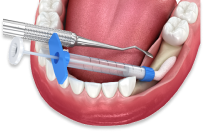
- Before the third day, you should begin rinsing your mouth with salt water two-three times a day. We recommend that you place the syringe along the tooth and push gently through the precision. Flush until the area is clean. You may have to irrigate the site for up to three weeks after your surgery.
1 Week After Surgery
- Numbness is a potential complication, especially when wisdom teeth are removed. If you are experiencing numbness after one week, we invite you to return to our office. Also, if you suffer from a fever, pain, or swelling, you may have an infection. We invite you to visit us after a week if these symptoms continue.
- A dry socket can occur between five-seven days after your extraction. It is a painful condition caused by the blood clot being dislodged. This can be a painful experience, but it will generally subside after forty-eight hours.
Other Complications
- A slightly elevated temperature is not uncommon. To reduce the temperature, we recommend that you take Tylenol of Ibuprofen. If your temperature persists, please contact our office.
- Before moving from lying down to standing, we recommend that you sit up for more a minute or more.
- If you feel something hard with your tongue from the extraction site, you are not feeling roots. Rather, they are bony walls that supported the tooth. These generally smooth out without extra care, but can be removed by our oral surgeon if necessary.
- We recommend using ointments such as Vaseline to keep your lips moist and to stop them from drying out.
- Your muscles may get swollen after this construction, making sore throats and painful swallowing common. Generally, this will subside within three days.
- Generally, you may have difficulty swallowing after surgery. This is a normal event that will resolve on its own.
Please feel free to contact [practice_name] today if you have any questions or would like to learn more about our quality surgical services in [city], [state].